
)
Flight time: 30 years and counting – Behind the scenes with our interim CEO
Pauls Cālītis, airBaltic’s Interim CEO and COO – his career at airBaltic began along with the very first days of the airline. ‘My first interaction with airBaltic happened even before the company was called airBaltic,’ Pauls Cālītis remembers. ‘I was invited for a pilot selection, and at the time the airline was still being established.’ That was exactly 30 years ago.
Now, after years serving as a captain and SVP Flight Operations – and for the past five years also as Chief Operations Officer and a board member of the airline – Cālītis’ career path has led him to the role of interim CEO. ‘Given my long-standing experience and how much airBaltic means to me, I accepted the role of interim CEO with a deep sense of responsibility and gratitude for the trust placed in me,’ he states.
Indeed, his is a unique story, which Cālītis reveals in this conversation.
To begin with, can you recall the first time you were introduced to airBaltic. What did you see?
I’d say that I saw airBaltic’s genesis. When I was invited for pilot selection, the company was still being formed, and it didn’t have its present name yet. The onboarding then was a longer process for pilots than it is today. Now we have a very established flow of how it’s done, but back then it was a brand-new company with no established processes behind it. Everything was being done for the first time.
I think it’s important to understand that, from day one, the company was created with a very clear intention to be something that’s of a completely different quality than what was available in the region at the time.
One of the airline’s founders was Scandinavian Airlines, or SAS, and the new airline was based on European standards. airBaltic was already something totally unique for the region at the time, both in terms of business practices and business mentality and in terms of operational standards and operational practices, which are at the core of any airline business. Because of this, airBaltic was very different already back then, and that’s still one of the defining factors for this company – why it is what it is today. The high quality and value of our product and constant adaptation and innovations are key features that we’ve maintained to the present day.
airBaltic’s fleet now consists of brand-new Airbus A220-300 aircraft, but at the beginning it flew small Saab 340 turboprops.
Yes, that was our first aircraft and the first aircraft I flew. At that time, we got our training and qualifications in Sweden, because Latvia did not have or offer the needed competencies. The company was so small that we all knew each other by name. The management team initially came from abroad, and it was a lot about getting to know and understand one another, understand the different cultures, the thinking behind what’s excepted from both sides. It was a very interesting time.
When did you join the management side of the business?
Having been with the company since its very first days, I’ve had the unique opportunity to see it from a time of very limited structure and few established processes. We didn’t call it that at the time, but I’d compare it to what’s now known as a startup.
That’s what we were – we were like a startup. It wasn’t like you came to work and did your own thing and let the bigger system take care of the rest. It was more like, ‘Let’s do this! But we don’t have that, so… OK, let’s do it this way! But who’s gonna do this?” It was very much like that. We all worked very closely, shoulder to shoulder, also with the other departments in the company.
Of course, we’ve grown very significantly since then, both in terms of scope and operations, and in the number of people. But having had that early experience and having it here now, I feel that in some ways it’s still similar. For me, this is more than just an airline and a place where to work. It’s something I’ve been involved with in building and experiencing.
We, the pilots, were spending more and more time together, not just flying but also helping to set up the operational part of the business. For example, putting together flight planning and crew planning systems, operations manuals, and so on. There was a big push in the industry at the time, because a common European Union standard in aviation was being introduced. It was called JAR-OPS, with JAR standing for Joint Aviation Requirements, meaning ‘joint’ for all the European countries. Now it’s known as EU-OPS. Up until then, almost every country and every airline had their own way of doing things, but with JAR-OPS, a unified system was created, and we had to adopt it within airBaltic as well.
So that’s how you got involved in management?
Yes, first informally and then formally, I was becoming more and more a part of the management team. After the first five years, I replaced the manager who was from SAS and responsible for flight operations.
This change was a big step for me, and it came with a big learning curve. It’s one thing to fly an airplane, and it’s one thing to be a part of the team, but it’s a completely different thing to be a team leader, which I had to become. It was a very valuable experience and also valuable growth for me as a person.
There have been many challenges in this job, and I remember the first serious crisis I had to deal with in my position. When Latvia joined the European Union in 2004, one of the first waves of impact we as a company felt, which eventually became a national issue, was an outflow of workforce. For us, it was an issue with pilots. With the opening of the EU market, our pilots had a license to work legally in any given EU country. With that, many of our pilots chose to leave and earn more money elsewhere. At the time, we were competitive in the Latvian market in terms of pilot salaries, but not on the European level. There was definitely a big difference, and we were losing pilots.
This was a catalyst, and we became one of the first airlines in the region to recruit pilots from other EU countries. We quickly adjusted to become competitive. airBaltic has always had to compete for professionals, not only at the local level but internationally as well. And it’s not just about salaries, there’s much more – the company and its internal culture, its reputation. We did overcome this challenge, and still to this day we’re able to recruit pilots from all over Europe.
When did you become a captain?
I’d have to check my logbook [laughs]. But that’s one of the benefits of a startup – there’s the possibility of very quick growth and advancement. I became a captain about two years after I started flying for airBaltic, in 1997.
Which captaincy skills do you think have helped you in your management role?
There are a lot of parallels to draw. I work in these two very different fields, but they’re complementary. In my case, it’s what you see is what you get – with my approach and my personality. In flying, I rely on my competence, steadiness, abilities, and communication style. Also, being able to process a lot of information in dynamic situations, to take it in quickly and focus on the best solution.
In terms of leadership, it’s very similar. I’m able to gather, make decisions, take the lead, and work with the team. When you want to become a captain, you go through leadership training as well, because being a captain is not only about technical skills or flying better than others; it’s also about being a leader, because you’ve been appointed the team leader of your crew. And as a team leader, you have to create a climate that generates openness, clarity, and cooperation. That’s the way to achieve a higher operational level and a better operational outcome. That’s the way I operate in the management side of things as well.
Basically, pilots can’t fool around with you because you know the job inside out.
That helps [laughs]. Thankfully, we have a very strong operational team, and the issues that do arise are managed very well, and relationships are upheld at the level where they should be.
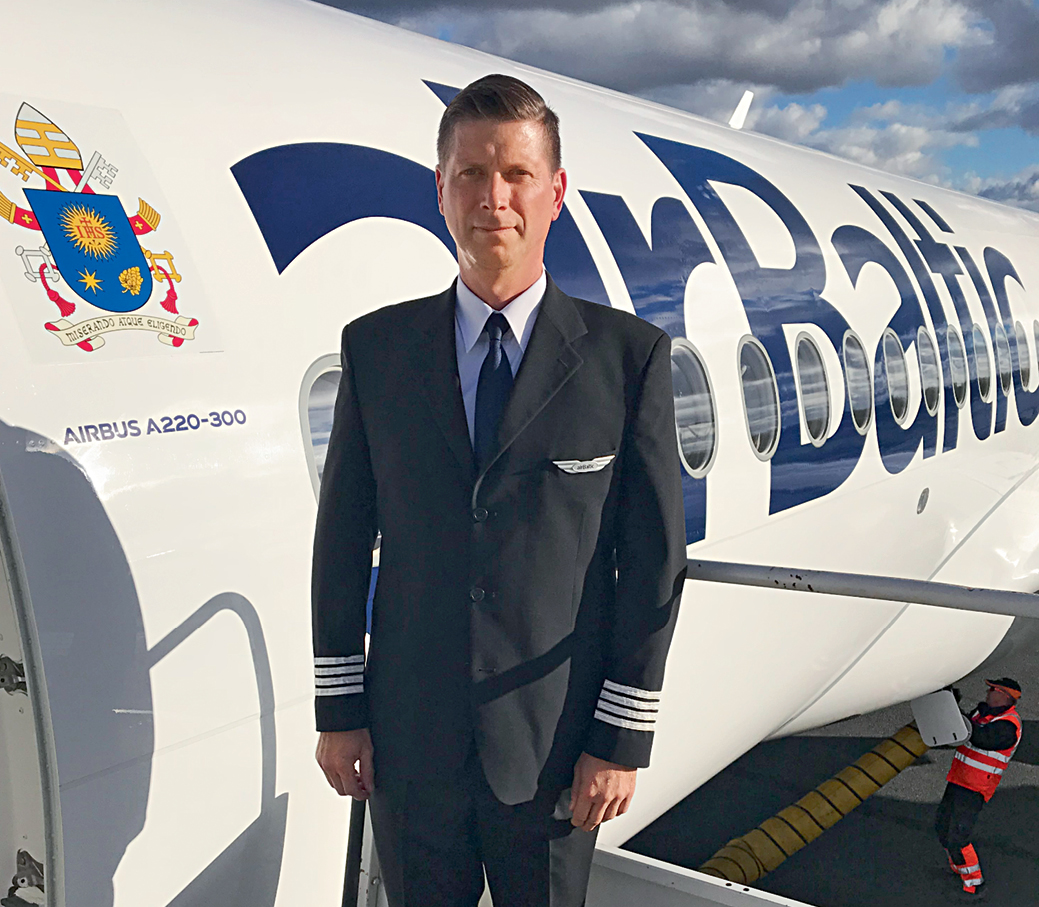 In September 2018, Cālītis captained the special airBaltic flight that took Pope Francis from Tallinn to Rome after visiting the Baltic states.
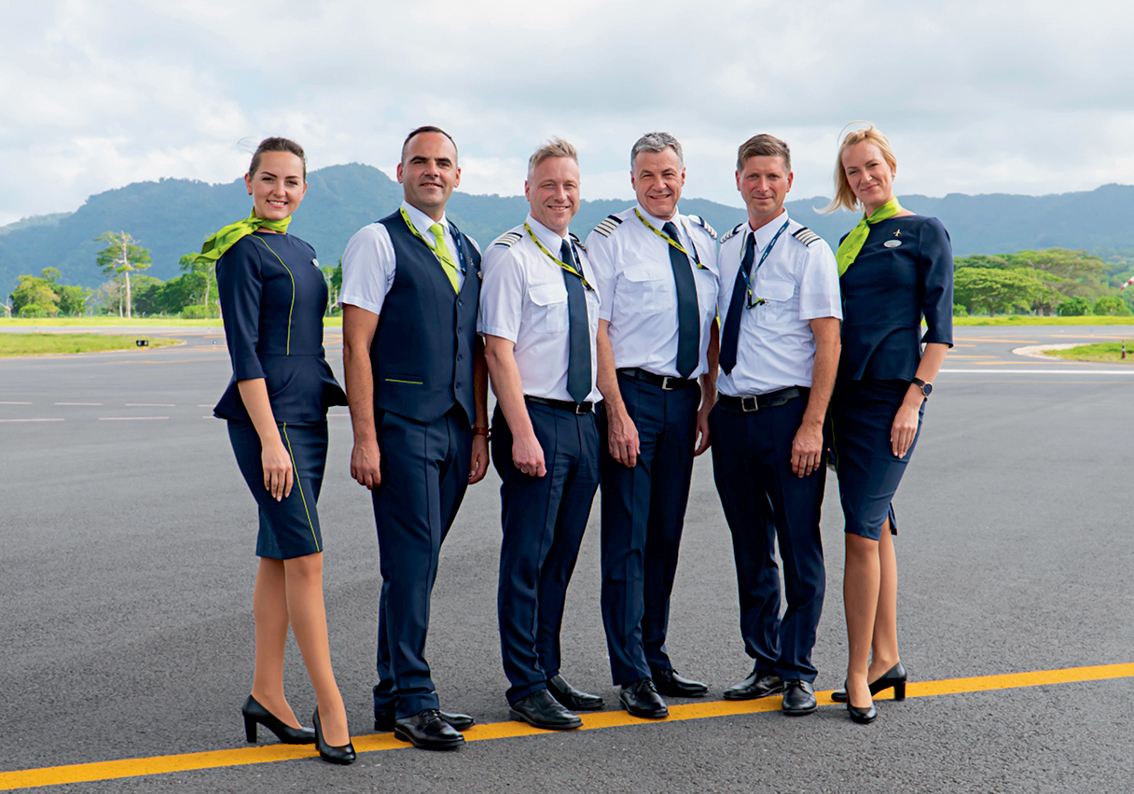 In 2019, Pauls Cālītis was one of the captains on the South Pacific Airbus Demo Tour.
In general, of course, I have great advantages because I know the company, I know how it works, I know the people. We have a bilateral understanding, a history, and experience working together, and that creates further effectiveness. But in any case, I’m delighted to see the breadth and depth of the competence my colleagues have; it really runs deep. Especially in the past few months, having the opportunity to delve into the details in different areas of airBaltic where I previously didn’t have a direct role. To get to know different people, to get to know them better and see their competency.
In your opinion, what are the three main turning points for airBaltic over the course of its 30-year-long journey?
I think the first one was Latvia joining the EU and the opening of the EU aviation market, when the strategy was to grow and be more aggressive. Before then – which is probably very hard to imagine nowadays – you needed to have specific traffic rights, which were negotiated bilaterally between countries. For example, each country regulated how many aircraft could fly per day between different cities. It was a highly regulated market, and in that sense very controlled and inefficient. Joining the EU opened this up, enabling any airline in any European country to fly as often as they wanted to anywhere they wanted; it opened the market to free competition.
It was a radically new model, and it completely changed the landscape of Europe in terms of the airline business. From very controlled, centralised operations to a very liberal, open, and dynamic market. airBaltic at that time had the right attitude and business strategy to embrace this opportunity. Some of the neighbouring countries and airlines did not do this, saying, ‘No, no, we’re stable, let’s stick to what we’re doing.’ But they’re no longer here. And I think that’s one of the key reasons why.
The second turning point would be the Latvian government becoming the majority shareholder and the decision that airBaltic needed a new fleet. The growth strategy had run into a situation that resulted in the Latvian government stepping in as the majority shareholder, and a strategy was developed that emphasised the importance of airBaltic. That the airline has a future, and that that future is very closely linked to establishing a new fleet. A new aircraft type had to be selected to be the basis for future growth.
It wasn’t an easy or risk-free decision to select the Bombardier CSeries (now the Airbus A220-300) because this aircraft hadn’t yet been built! There was a lot of talk in the industry that this was not a wise choice, that a conventional aircraft type would be better for us. But time has proven this to have been the right decision.
And the third turning point was the post-Covid restart with a single, consolidated fleet. We entered the Covid-19 pandemic operating three different types of fleets, and after the Covid shutdown, we restarted as a single-fleet operation based on the most modern aircraft available. All the ideas and strategy elements that had been put together over the last decades and which until then had really only existed on Excel sheets and PowerPoint presentation slides, now became a reality. We already had the new aircraft, and we decided to have a single-aircraft fleet. That was a very rewarding time.
Now we have 50 aircraft in our fleet, and we are the most experienced in the world with this type of aircraft. It’s a very successful aircraft, it has proven itself, and, most importantly, it has a very bright future ahead of it. Because it’s at the leading edge of efficiency and economy. The aviation industry is very slow in creating new products to bring into the market, and it’s also very expensive to do so. There’s currently no product being planned to replace this one, because there’s simply not enough new technology developed to create sufficient improvements to warrant creating a new aircraft. You need to have a strong paradigm shift or the next generation of something specific – engines or fuel source – in order to make such an investment.
So, because of that, this aircraft is currently at the forefront of its class. This means it has its future ahead of it. Whereas, had we made the decision back then to take a different aircraft, we would now be having discussions about going for this new aircraft. The Airbus A220-300 has proven itself, and it’s proven itself within the business that we do here as airBaltic at airBaltic.
But we also have other important business. In addition to our network flying, we also fly as an ACMI provider. This aircraft and our product have proven themselves in this area as well. So, we have two strong legs to stand on. It’s a combination of having a company that knows what it’s doing, does it well, and has the right product to offer with the right aircraft.
When the Airbus A220-300 aircraft was being designed – and it was designed completely from scratch – how much were you involved? Did you work together with Bombardier, which was the original producer of this aircraft type?
Yes, this programme used to belong to Bombardier; it was only later acquired by Airbus. For sure, this was a unique and very special experience, and it’s something that I very much appreciate. New aircraft in the passenger commercial sector don’t come along very often. But I had the pleasure to be involved in the process as the aircraft was still being designed, as it was being tested, and as it was being brought into operation.
Had it been one of the other larger manufacturers at the time, then, of course, we would have been just another customer queuing in line; we would have received a product and flown it. But Bombardier was a bit special, because they were also a smaller company, an underdog, just like airBaltic. They were very open and looking for feedback from their customers. It was a unique experience. Many pilots can have a very long and rich career and never have that experience.
You were part of the crew that brought the first Airbus A220-300 aircraft to Riga.
Yes, that was the culmination of the whole process – taking this aircraft from the factory to Riga.
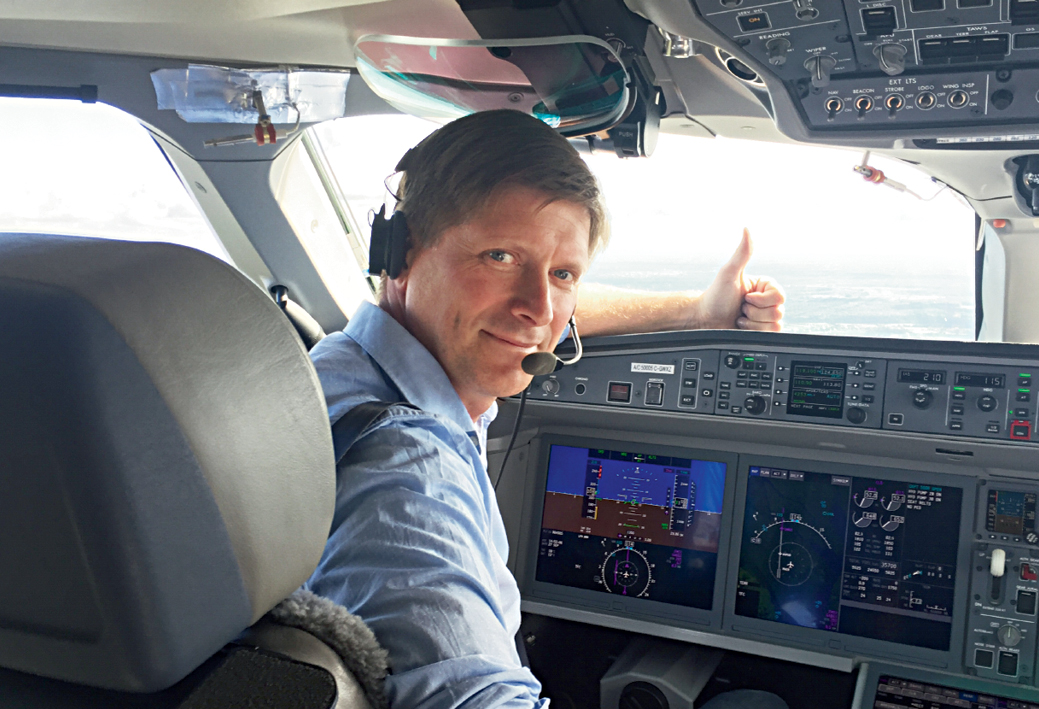 Cālītis’ first flight with the Airbus A220-300 in Mirabel, Canada, to test the aircraft in September 2016.
And in 2025, just a few months ago, we received our 50th Airbus A220-300 aircraft. Before our flight crew flew it back, we had a special event in Mirabel, Canada, where the aircraft are made.
It was a very nice way to round out one part of the journey, but the journey continues. It’s not really about the aircraft count, because it has been more important to see the success of the aircraft. And from the company’s perspective, that the people using the aircraft, the crews, have accepted it and really fallen in love with it. That’s not a given; it means that the aircraft works. And even more important, that our passengers have accepted it and feel good in it. They’re used to it.
There have been difficulties, of course. For example, if you look at the challenges and the issues we had with the engines over the years. But we’ve always been confident that it will get better, that this is something that will pass. And we’re now seeing very important signs and data that the situation is in fact slowly turning around and improving.
You describe this as being a journey, and I feel this is a good point at which to talk about how the recent leadership transition has affected the company.
We definitely haven’t stopped in any pit stop, we’re still on course and we’re moving quickly. Our fundamental business – carrying passengers – is strong and on-going, and this has been our highest priority. We had to ensure that, despite having a transition in leadership, there’s still a clear focus on the execution of our core business. That’s flying, and that’s the commercial part of the business as well. And to do it all in a way that meets and exceeds expectations. Not that there’s any doubt that we could do it. The strength and dedication of our leadership team have been instrumental in maintaining stability and focus, and it’s important that that stability and focus is shown and emphasised both from myself and the team.We’re now at our busiest part of the year, and that’s why these months are the most important ones both from the business and operational perspective. It’s the most intense time of year, and we really need that everybody is focused and working. Having said that, our results are improving – we’re having much more stable, better-performing operations than in previous summers, because we have fewer outside disruptions. Also, our commercial performance is stronger than last year.
"Stability in aviation – and during turbulence – is never accidental."
It’s the result of countless choices, any one of which, made differently, could have set us on another course entirely. Together with the airBaltic team, I remain committed to maintaining that clarity of purpose.
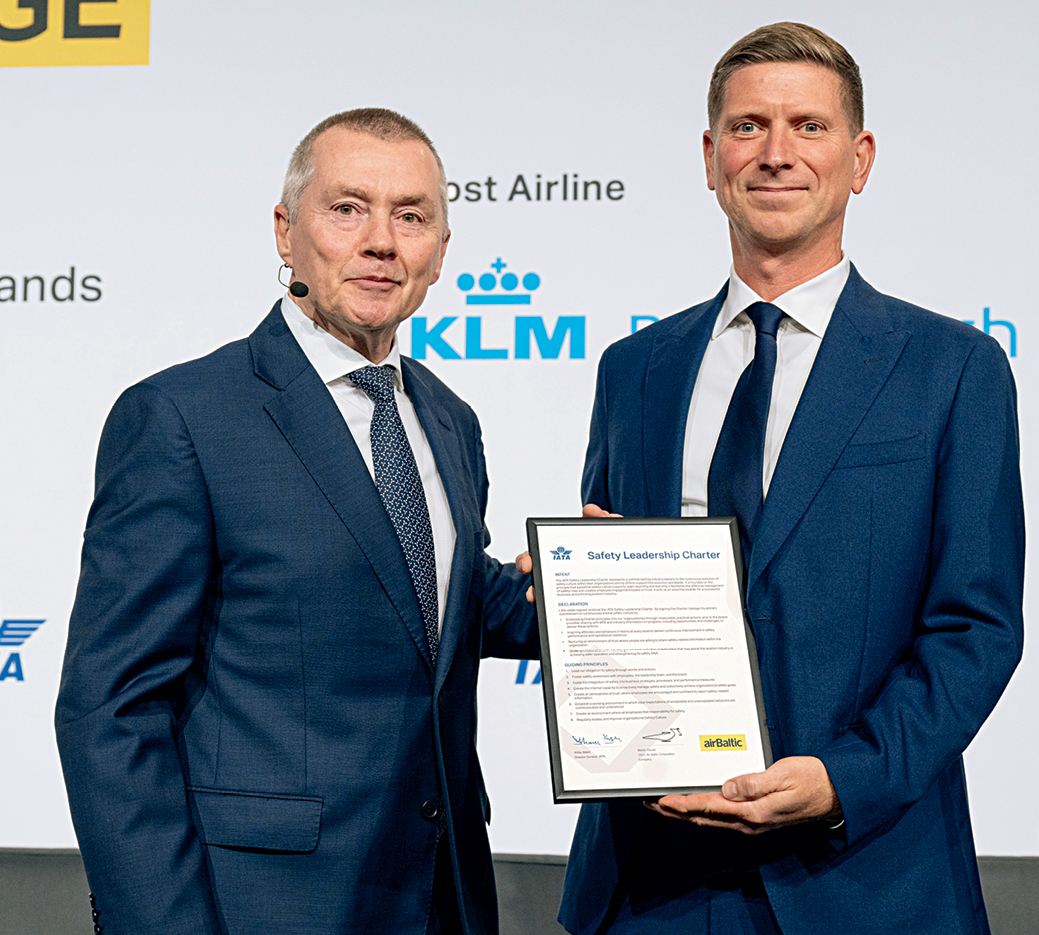 Together with Willie Walsh, the director general of the International Air Transport Association (IATA), after signing the IATA Safety Leadership Charter in Amsterdam in 2023.
Also, IPO is definitely our goal, and we’re working to make sure that our strategy and business plan is in place to reach that goal. There’s a focus on this at all levels of the company, each working towards supporting it. Our supervisory board is also involved and actively engaged, positively influencing and promoting our path towards an IPO. Our majority shareholder, the Latvian government, has also been supportive and clear on its expectations.
Concluding this conversation, one might ask why you’re not bored yet, working for 30 years at the same company. But I think your situation is unique, having started out as a pilot and now taking the position of interim CEO.
For sure, these days I guess that’s not the standard path. I get it, building a career nowadays means changing companies, maybe even different areas and different professions. But I’ve had quite a unique experience within airBaltic, and it wasn’t something that was planned out. It just happened this way, and I value that greatly, to have this career here.
For me, it’s important that not only has the company grown, but I’ve been able to grow with it as well. There’ve been so many different periods, changes, challenges, and things to do – that’s where the excitement and motivation has come from. There’s always a new challenge and new circumstances, a new dimension, a new development. Even though it’s one company, it has changed a lot. I’ve gained a lot of experience in that process.
Do you still fly?
I’m not currently flying as a line pilot. The past two years have been very intense, so I’ve stepped away from active flying, but I definitely maintain my license. I keep this important part of my professional career, and I value it very much – it’s something that has been with me from the start.